Monday, 19 January 2015


Frogs, Frogs and More Frogs

Poison Dart Frog

There are lots of really exotic frogs at the current exhibit, Frogs: A Chorus of Colour. Although these frogs certainly contribute a WOW! Factor and will bring a multitude of visitors to RBG, it is our very own native frogs that play a role in the natural lands of RBG.


Chinese Gliding Frog


Green Frog - the most common frog in RBG wetlands.
As amphibians, frogs spend the egg and larval stages of their life cycle in the water and so are susceptible to changes in water quality. Thus they are known as ecological indicators since population numbers will decline as pollution of water increases and as wetlands are reduced.  Prior to 1950 there were 8 species of frogs and 1 toad species at RBG, with that number bottoming out at 2 frog and 1 toad species in the early 90’s. With the habitat restoration efforts in RBG wetlands areas the number of species has increased to 5 frog and 1 toad, although population sizes are still below expectations.  RBG scientists, along with support from Environment Canada, will perform studies to determine what factors are restricting the recovery of our frog populations.

Monitoring of frog populations is done by listening for the breeding calls of the male frogs in the spring. RBG staff and many volunteers use the Marsh Monitoring Program of Bird Studies Canada to map the locations of frogs throughout Cootes Paradise and Grindstone Marshes.
The six species of frogs and toad present on RBG properties are: Green Frogs (over 50%), Gray Treefrogs, American Toads (25%), Northern Leopard Frogs, Wood Frogs and Spring Peepers although the latter two are still quite rare. The species that formerly inhabited RBG are American Bullfrogs, Western Chorus Frog and Pickerel Frog.
Gray Treefrog
Wood Frog - rare on RBG property

Spring Peeper - rare on RBG property


To hear the various frog calls visit this website:

Thanks goes to RBG for their Fact Sheet on Amphibians (Jan 2015)


Monday, 12 January 2015

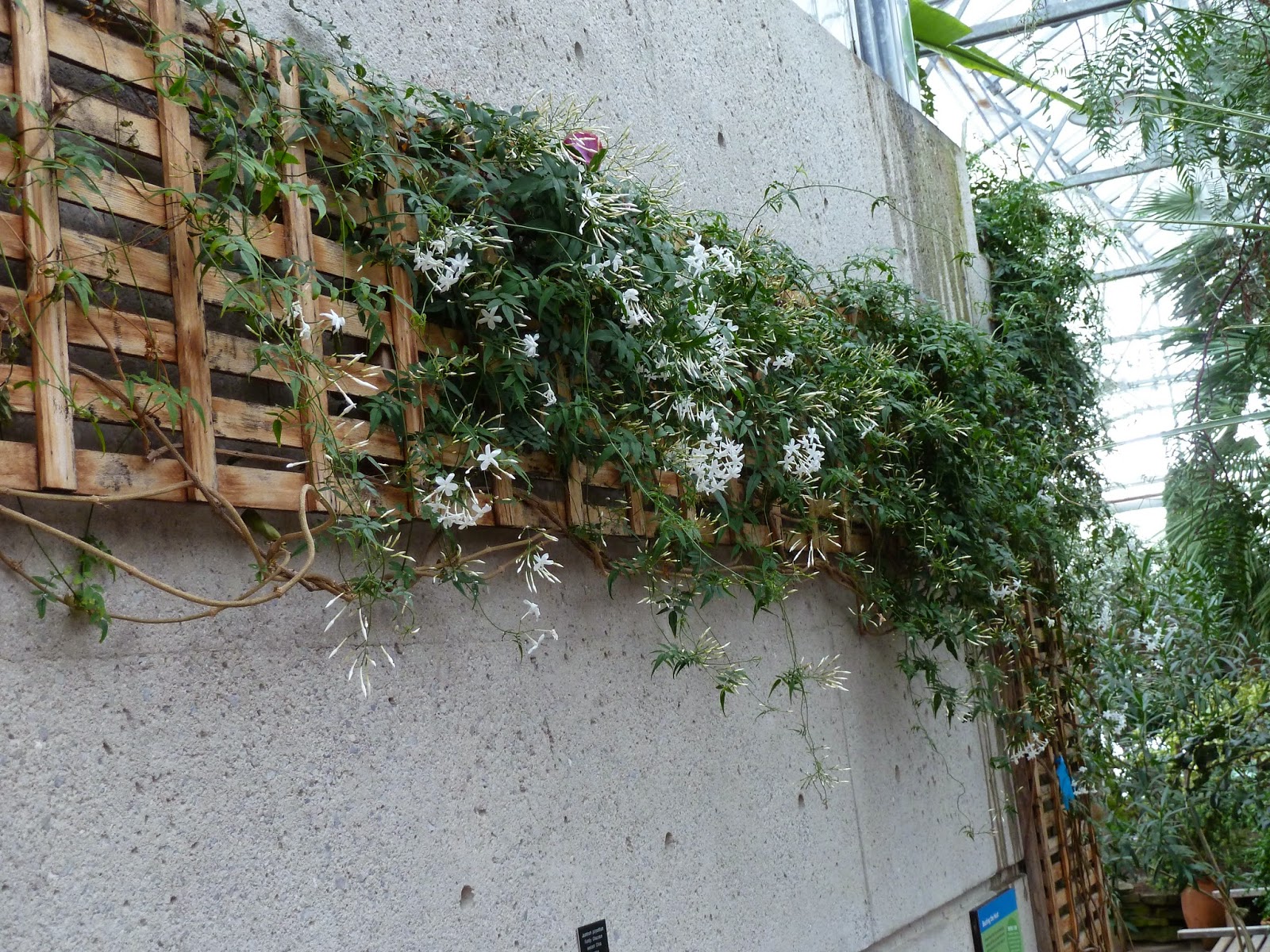
Jasminum polyanthum

Jasminum polyanthum in the
Mediterranean Garden
The Mediterranean Garden is a constant source of sensory relief during our winter months.  Not only is it warm and providing of visual delights in the form of lush green plants and a variety of blooms and fruits, but it can also be an oasis of enticing scents.  Currently with the jasmine (Jasminum polyanthum) coming into full bloom the air is filled with its strong fragrance.  

The long buds of the jasmine flower

The extensive evergreen vine is filled with long white delicate looking buds although this species is often known for having pink buds.  The star shaped white flowers are five-petalled and most aromatic in the morning and evening.  
The white flower has 5 petals


Jasminum polyanthum with the more
typical pink buds.
Jasmine belongs to the Oleaceae family which contains some members that we are quite familiar with, including lilacs and forsythia.  However all of the 200+ species of jasmine are native to tropical and warm temperate region with Jasminum polyanthum being native to China and Myanmar. With it belonging to hardiness zones 8 to 11 it can only be grown as a house plant in Canada.  In Australia and New Zealand it is often considered to be invasive due to the natural layering of its stems.


The name is derived from the Persian “yasmin” meaning “gift from god”  The true nature of this gift can be seen in the many aromatherapy applications with the species J. grandiflorum and J. officinale being used for extraction of the oils.  Benefits include acting as an antidepressant; relaxing nerves, relieving muscle spasms and cramping. Research has shown that smelling jasmine oil can also enhance mental alertness, and application to the skin increases elasticity to smooth the skin and also promotes healing.

So head on down to the Med House while this delightful plant is still in bloom.  Soak in the sights of the whole garden, but be sure to experience the scents of the jasmine.


Monday, 5 January 2015

The Turner Pavilion


One of the features of Holiday Traditions this year was the transformation of the Turner Pavilion into Santa’s Cabin.  


Children and their families walked through the Christmas decorated Oak Allee, past the Candy Cane Garden and through the back door of the cabin to visit RBG’s Santa Claus.  What a wonderful use for the teahouse!

Looking back at RBG Centre.


Oak Allee leading from RBG Centre to
Turner Pavilion
So, that leads one to wondering about the history of Turner Pavilion.  J. Austin Floyd was the Landscape Architect who developed the master plan for Hendrie Park in the early 1960’s to include a pavilion. With the development of the Centennial Rose Garden in Hendrie Park people realized that the long walkway from RBG Headquarters needed a focus at the end and so in 1966 a building fund was established to erect such a structure.


Miss Edith H. Turner came forward with a substantial contribution and so the pavilion, designed by Hamilton Architect Alex German, was erected and officially opened on June 22, 1974.  Miss Turner requested that the building be dedicated to the memory of her parents, Sarah and George A. Turner.  George was a developer in the north east area of Hamilton.  Edith, who never worked, accrued her wealth by turning the $250,000 she inherited from her parents into millions through successfully playing the stock market.  Other RBG projects have benefited from her donations. Edith H. Turner died in 1983.  The Edith H. Turner Foundation Fund exists today with the purpose of assisting and providing funds in the fields of education, health, humanities and social development in Hamilton. The Hamilton Community Foundation manages these funds. Read more about this foundation in a recent Spectator article.  http://www.thespec.com/living-story/4594306-paul-wilson-the-best-friend-hamilton-s-never-heard-of/

The original use of the Turner Pavilion was the provision of public restrooms in Hendrie and a sales station that was operated by the Auxiliary.  The garden staff were given storage facilities in the basement.  However, with the expansion of RBG Headquarters, the Auxiliary was able to move its sales station to the Floral Art Shop in the Centre.  The Pavilion was converted to a tearoom for use by visitors to the Gardens.
 

 And so the story continues, with a new and innovative way found to bring visitors through Hendrie Park during the winter months of Holiday Traditions in order to visit Santa in his cabin.  Santa’s reindeer were located here when they visited, as well as an ice sculpture. Decorations along Oak Allee added to the festive spirit and the magic of a night time visit.

Monday, 15 December 2014


Euphorbia pulcherrima (Poinsettia)

The plant that is most commonly associated with Christmas is the poinsettia.  You can certainly see a large number of large poinsettia plants decorating areas of RBG centre, especially around the train displays and forming a large, impressive tree in the bulb room. In fact there are over 500 plants in the building.
The Poinsettia tree in the bulb room.
Dr. Joel Poinsett
The poinsettia is a member of the spurge or Euphorbia genus, with the species name pulcherrima, meaning 'most beautiful' (Euphorbia pulcherrima). It is native to southern Mexico and Guatemala, gaining its common name from Dr. Joel Roberts Poinsett. Poinsett was an amateur botanist and the first U.S. Ambassador to Mexico in 1820’s, discovering the poinsettia in wilderness of the Taxco area.  He sent some of these plants back to cultivate in his greenhouses in South Carolina, distributing them to friends and botanical gardens. Originally they were known to people as ‘Mexican fire plant” or “painted leaf” but eventually the name Poinsettia gained popularity, recognizing Poinsett’s role in introducing the plant to America.


An old Mexican legend describes the association of poinsettias with Christmas. A poor Mexican girl wanted to give baby Jesus a present at the Christmas eve services, but not being able to afford anything picked a handful of weeds from the roadside. Once laid at the base of the nativity scene the weeds burst into bright red flowers. In Mexico they are known as Flores de Noche Buena (Spanish for "flowers of the holy night").


Red is the most popular colour making up more than
half of the Poinsettia sales, followed by white and pink.
Poinsettia’s can come in a variety of colours such as the popular flaming red, orange, pale green, cream, pink, white or marbled.  They can range in size up to that of a small tree 4 metres high.  

A 12 foot tall Poinsettia in Florida

A gangly natural Poinsettia grown in
the tropics.

The red coloured structure is not the actual flower, but rather they are bracts, or modified leaves. At the centre of ring of bracts is a cluster of green and yellow structures called cyathia.  Each cyathium is an inflorescence, or flower cluster, comprised of many individual male flowers, and a single female flower.

The ring of bracts can be seen extending out from below
the green and yellow cyathia.
 Each cyathium contains an immature cluster of
male flowers with one single female in the middle.

The male flowers are more mature and pollen
can be seen on the stamens.
Poinsettia will last longer if bought when the
cyathia are not developed and resemble 

little peas.

Each cyathium bears a two-lipped, yellow gland
that produces nectar to attract insects.

The bracts of the Poinsettia are originally green
and gain colour as the plant matures.
Poinsettias (Euphorbia pulcherrima) can be identified as members of the Euphorbiaceae family because they release a milky sap, containing latex, when leaves or branches are broken. Some people may develop skin irritation from direct exposure to the milky sap. However it is not poisonous.

Here you can see the milky
sap being released at the points
where the bracts were removed.

Monday, 8 December 2014

The American Sycamore (Platanus occidentalis)

Peter Langballe led the Sunday walk,
while Mary Lyn Brown and Renata were two of
those who joined in.
A great way to spend a couple of hours on a Sunday afternoon is to go on one of RBG’s guided Back to Nature Walks led by an Auxiliary member.  Late fall provides different views along the trails due to the absence of foliage that normally limits how far one can see the wooded landscape.  There is still much to see, too much to describe here.  

One of several sycamore trees seen on
the trail.


One of the plants of visual  interest is the Sycamore tree (Platanus occidentalis) also known as the American sycamore, American plane tree or buttonwood, native to eastern North America. There are several of these trees along the shores of South Pasture Swamp with the large size, the bark and the fruit all catching your attention.  


The peeling bark produces the "camouflage" pattern


The bark peels off in irregular strips, leaving behind splotches of brown or gray, producing a camouflage effect.  From a distance across the swamp the towering trees stand out due to their white colour. These trees commonly inhabit wet areas. At up to fifteen feet in diameter, the sycamore develops the broadest trunk of any native tree. In fact the genus name is derived from “platy” which is Greek for “broad”.


The white sycamores are readily visible in the background.

The fruit provides great winter interest. This fruit forms brown seed balls, about one inch in diameter, which remain hanging from the tree singly attached by a long stalk.  Inside the fruit is a tightly packed cluster of “achenes” which are small, dry, one-seeded fruits that do not split at maturity, each one sporting a hairy tuft to help with dispersal, much like the dandelion. The name ‘buttonwood’ for the sycamore is due to these fruits which may stay on the tree throughout the winter, breaking apart in the wind to disperse the seeds.


The brown seed balls of the fruit.

A close up view of the seed ball.


The inside of the seed ball.
Leaf from the sycamore tree


The leaf of the tree is much like a maple leaf.  In fact Platanus acerifolia, commonly known as the London plane tree, is a hybrid resulting from the cross of Platanus occidentalis and Platanus orientalis.  It is often used in urban plantings in place of the American sycamore due to its high tolerance to pollution and its production of shade.  One way to distinguish it from the native sycamore is that the fruit balls hang in pairs. 
Note the alternate attachment
of the leaves

It has been stated that the maple leaf found on the Canadian penny is actually from this tree.  Although the sycamore leaf and maple leaf are similar, maple leaves grow ‘opposite’ on the branch while the sycamore has an ‘alternate’ arrangement.  


There is so much more information to be found about the sycamore tree.  Have a look at the following web site: http://ontariotrees.com/main/species.php?id=2083

Monday, 1 December 2014

The Pinetum

The Pinetum is an area in the Arboretum often overlooked by visitors to RBG. Unlike the name “Pinetum” seems to imply, pines are not the only variety of trees to be found in this area.  Instead, there is a collection of a variety of conifers that has seen significant additions this past year. The pine family (Pinaceae) being the largest conifer family is rightly well represented with many specimens from the largest genera of Pinus (pines), Abies (true firs) and Picea (spruce) as well as the less populated genera of larches, hemlocks and Douglas fir.  There are also a large number of members of the cypress family (Cupressaceae) in the collection, namely the popular genus Juniperus (juni pers) along with many Chamaecyparis (false cypress) and the newer additions of Cryptomeria japonica (Japanese cedars) found at the entrance to the Pinetum Trail.


Douglas fir

There is so much that can be written about this collection, but in keeping with the approaching season, let’s look more closely at the pine, firs and spruce that are often used as Christmas trees and examine how they can be differentiated. 

If you would like to see the more popular Christmas tree choices have a look here:


The best place to start conifer identification is to look at the needles, since pine needles are bundled with usually 2, 3 or 5 in a bundle while spruce and fir needles are found singly. Take a look at the chart below to see the major differences between these two. (For brevity cones and tree shape will not be dealt with in this article.)


Needle characteristics
Spruce (Picea)
Fir (Abies)
SHAPE
Four sided – will ‘roll’ between your fingers
Flat – will not roll
FEEL
Stiff, sharply pointed
Softer than spruce
LENGTH
No consistent differences
ARRANGEMENT ON THE BRANCH
In spirals around the branch giving it a three dimensional look.
The branch has a flattened appearance
WOOD ON BRANCHES
Needles are attached to woody projections, so branch is rough after needles fall
Branch is smooth after needles fall with a scar left by the needle


A spruce with four sided needles.
Needles are attached singly and spiral
around the branch.
A fir with flat needles.
Needles are attached singly and tend to spread
to the sides to give a flattened appearance to the branch.
A pine branch


There are up to 100 species of pines, however the most common Ontario species can be differentiated by examining the needles.  The Eastern White Pine has long needles in bunches of 5, while the Red Pine has long needles in bunches of 2.  Pitch pine needles occur in threes.  Scots Pine and Jack Pine both have shorter needles in twos, but the Scots Pine needles are twisted, while those of Jack Pine are not.


White pine with needles in groups of five


Red pine with needles in groups of two


Jack pine - needles are in twos, but shorter than
the Red pine


To learn more about any of the genera of conifers, go to the web site for Ontario Trees & Shrubs and click on the genus name.  You can also use the list on the left of the page to change your search criteria.